By Andriana Simos.
The Jews of Greece exhibition at the Sydney Jewish Museum is set to close on February 18 but documentary filmmaker Carol Gordon says the temporary exhibition is only one element of ‘The Shira’s Journey Project.’
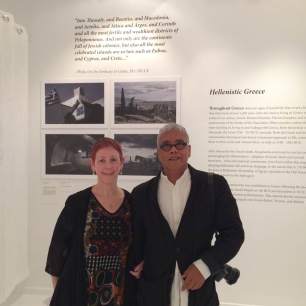
“After researching the Jewish community of Greece for over thirty years, I decided to write a screenplay describing their journey called ‘Shira’s Journey.’ Unfortunately, feature films are notoriously difficult to produce so I decided to self-publish the screenplay as a book,” Carol says.
“I immediately approached my good friend and photographer of the exhibition, Emmanuel Santos, with the idea and he was excited to produce photographs for the book.”
It is here where Carol’s vision for ‘The Shira’s Journey Project’ finally came to life. From educating the world about the scarcely known Jewish communities of Greece, the project grew to encompass three elements: a book, a documentary and a photographic exhibition.
“We went to Greece in September-October 2013 and decided that we couldn’t waste a trip to Greece just to take photographs. So we made a documentary as well,” she says.
“By October 2014, the film, ‘Following Shira’s Journey: A Greek Jewish Odyssey,’ was ready and it showed at the Greek Film Festival.”
The exhibition part of the project was at the Jewish Museum of Australia in Melbourne from April to September 2017 but since October 25, 2017, the exhibition has also been available to view at the Sydney Jewish Museum. It showcases the work of photographer Emmanuel Santos and documentary filmmakers Carol Gordon and Natalie Cunningham, and provides an insight into the life of Romaniote Jews, Sephardim Jews (Jews of Spain) and the Ashkenazi Jews of Europe.
Carol Gordon, however, says that although she is very happy and proud that the exhibition is being showcased at the Sydney Jewish Museum, her mission is not done yet.
“I still want the exhibition to travel widely and to spread the message about these communities and how 87% of Jews were murdered in the Holocaust,” she explains.
“I would also love to create an education package. The documentary is 52 minutes long however, there are 40hrs of footage containing important interviews and community profiles and my aim is to edit it all. I want to subtitle it and create profiles to be used as an education package.
“Even though it’s a really hard job because there is currently no funding, I won’t rest until it’s done. It’s just a case of looking for someone who will sponsor and fund the next stage of the project.”
In fact, this persistence and determination to “get the project done” becomes even clearer when Carol speaks about the Holocaust survivors themselves.
“There are so many amazing stories but I do remember one about a girl called Naki who is now 90 years old and still full of spirit,” Carol says.
“Naki was a Greek Jew from Larissa and she was helped by neighbours and the Greek Orthodox Church to go into hiding. She escaped Auschwitz but being in hiding wasn’t easy. One day she wanted to visit her friends in Larissa and being a very wilful 16-year-old, her parents eventually let her go. She felt a sense of security because she wasn’t registered as a Jew when she went into hiding.
“The next day though, after arriving in Larissa, the Nazi’s went to round up the Jews. She was betrayed by the tenants who lived in her house and was instantly take prisoner. She was kept there for two weeks until she finally said to them: “why don’t you go to my village and ask them about me?” It was a very dangerous thing to do as she wasn’t actually from there.
“But the Nazi’s returned and said “we couldn’t get to your village because the resistance fighters have blown up the road.” So they let her go and she went back into hiding.”
Carol says that it’s stories like these that she has recorded and wishes to include in her education package one day.
“The survivors are getting older now and there is a sense of urgency to get their stories before it’s too late,” she says.
On that note, Carol also encourages everyone to go see the Jews of Greece exhibition before it closes to gain a deeper understanding of the extent of their suffering.
“By spreading and reading these stories, it’s as though some meaning came out of their terrible deaths. Honour the people that were murdered by remembering them,” she says with emphasis.
Read more about The Shira’s Journey project here or give it a ‘like’ on Facebook.
 Simos Standpoints