Cinematic films about climate change are on the rise and they are leading to increased public awareness about the topic. Or are they?
Andriana Simos investigates.
DURING the launch of her 2020 presidential campaign, American Senator Kamala Harris (2019) argued that we need to address climate change based on “science fact not science fiction.” She was wrong. The truth is, we need both. In a world where we can see and feel the effects of climate change more severely and closer to home than ever before, science fiction can actually help us negotiate our way out of disaster.
This important role of science fiction can clearly be seen almost 15 years after the release of Roland Emmerich’s film, The Day After Tomorrow (2004). Although global warming occurs at an absurd rate in the film, the science of climate change has still been portrayed in a balanced way. Powerful visuals of dramatic weather events such as tidal wave floods in Manhattan and tornadoes in Los Angeles, effectively highlight the dangerous consequences of climate change (The Day After Tomorrow, 2004). At the same time, the film shows how these dangers are not always deadly and can be overcome, as the son of paleoclimate scientist, Jack Hall, survives the new ice age on the Northern Hemisphere (The Day After Tomorrow, 2004).

The Statue of Liberty is covered in ice during the new ice age in The Day After Tomorrow. Picture: 20th Century Fox.
According to Doctor Don Sillence (2019, pers. comm., 15 July), lecturer at the School of Arts and Media at the University of New South Wales, this change from a message of extinction to a survivor’s tale can have both positive and negative impacts on the public’s understanding of climate change science and their actions towards it.
“I worry about the impact of our culture’s fascination with the individual or ‘hero’s journey.’ In many ways, I think it distracts from the necessity of collective action and allows the public to contemplate their own role in climate change from a distance,” Dr Sillence explains.
“That said, the film’s attempt to balance the dangers of climate change with a story of survival is powerful, as hope remains central to all human agency and encourages engagement around how to act appropriately when dealing with climate change” (D Sillence 2019, pers. comm., 15 July).
Recent psychological studies carried out in the United States and Germany about the impact of the science fiction film on people’s perception of climate change, support Dr Sillence’s view. The results showed that “the film did increase awareness and concern about the potential effects of climate change and had positive, although short-lived, effects on willingness to act” in the public sphere (Sakellari 2015, p. 831).
But what about feeling more motivated to do something about climate change in the political sphere? The Day After Tomorrow (2004) highlights how this is the sphere where most of the activism should take place as scientists face immediate and tangible scepticism from politicians during public debates about climate change.
In fact, this is evident when Jack Hall attends a United Nations conference to “advance a climate change theory that continued global warming could initiate a cooling cycle and plunge the Northern Hemisphere into a new ice age” (Burg 2012, p. 12).
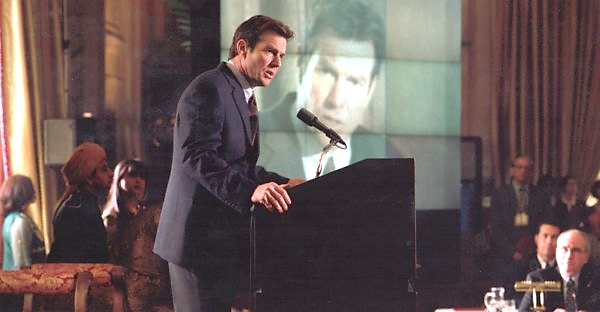
Paleoclimate scientist, Jack Hall (centre), is trying to convince the Vice President that climate change is real at a United Nations conference. Picture: 20th Century Fox.
Even though Hall argues that “if we don’t act now it will be too late,” he comes up against the Vice President of the United States who “asserts that enough scientific uncertainty remains to warrant rejection of environmental legislation that could harm economic growth” (Burg 2012, p. 12). This nonchalance from the White House highlights how the science of climate change remains contested by people with power and this leads to the public experiencing the real risks associated with climate change.
However, it is important to note that the film does attempt to show how this anti-climate change view can be altered. In fact, after witnessing the climate disasters and following intense pressure from Jack Hall, the Vice President slowly realises the error of this thinking that “American society could use nature’s resources without consequences” (Hammond & Breton 2014, p. 314).
Associate Professor Alex Sen Gupta (2019, pers. comm., 12 July), from the Climate Change Research Centre, argues that it is this balanced way of portraying how the dangers of climate change scepticism can be mitigated, which inspires the public to protest real-world politicians and their policies.
“The film is actually disturbingly realistic about the politics of climate change as there are still politicians today who say they don’t believe in climate change. There are also big coal and energy groups that are pushing very hard for inaction on climate change and this is certainly influencing the steps politicians are taking,” Associate Professor Gupta says.
“So I think the film really raised awareness to the general public about the role of politics in climate change science and I think that indirectly, it would have had a positive effect on activities related to mitigation in this sphere” (AS Gupta 2019, pers. comm., 12 July).
Now that we have established the effectiveness of science fiction in generating awareness and engagement from the public, can the same be said for the use of science fact in cinema? An Inconvenient Truth (2006), the documentary featuring Al Gore, the former Vice President of the United States, gives us the perfect answer.
Released in 2006, the documentary clearly represents the dangers of climate change through the use of factual graphs and data. One specific graph of “carbon dioxide and temperature data over the past 650 000 years” really drives home the idea that “carbon dioxide levels will be off the charts in the next 50 years if the rate of fossil fuel consumption continues its current trend” (Nolan 2010, p. 644). At the same time, this numerical data is complemented by startling pictures of retreating glaciers, polar bears having to swim up to 96 kilometres to find ice and cities, such as Lower Manhattan, underwater (An Inconvenient Truth, 2006).
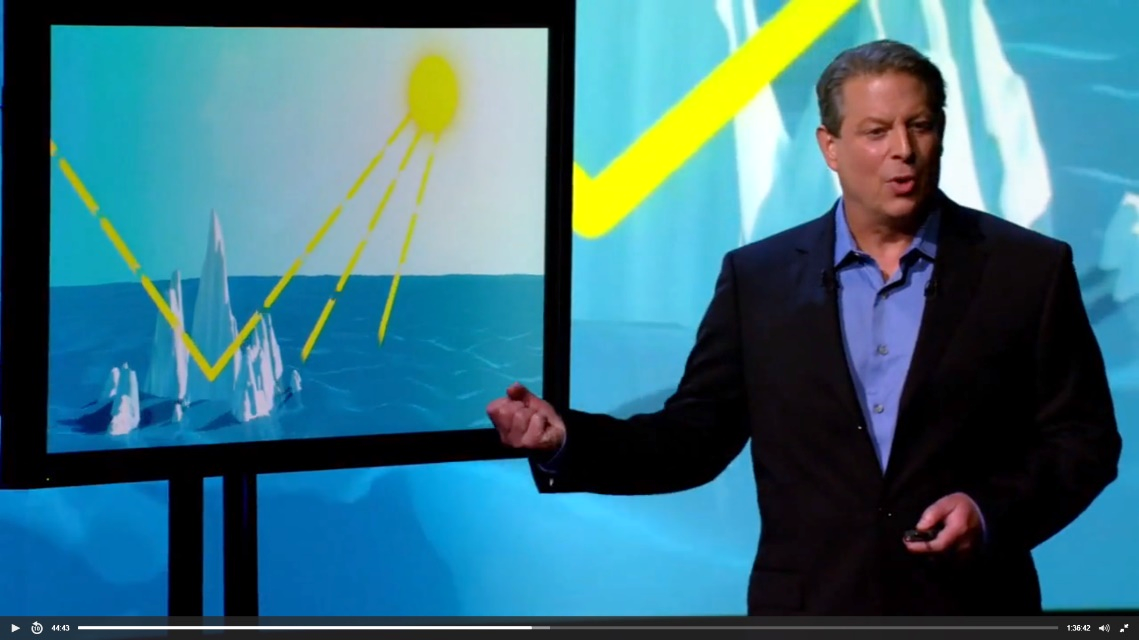
Former Vice President of the United States, Al Gore, shows powerful graphics of retreating glaciers in the documentary, An Inconvenient Truth. Picture: Paramount Classics.
But beyond eliciting fear in the public about these climate change risks, An Inconvenient Truth (2006) does end on a “hopeful and instructive note with suggestions for how individuals can reduce greenhouse gas emissions in their everyday lives” (Nolan 2010, p. 644). These suggestions range from recycling to speaking up in the community, buying a hybrid car and encouraging people to watch the documentary.
This skilful framing of “global warming as a problem we share but can solve together” is important for the depiction of climate change in film (Nolan 2010, p. 832). Associate Professor Gupta (2019, pers. comm., 12 July) says that it not only convinces the audience of the reality and seriousness of the global warming crisis, but it also motivates viewers to take individual and political action.
“I think the biggest effect of the documentary was probably in the political and public sphere. It made politicians and the public listen to information on climate change because it was coming from a prominent politician,” Associate Professor Gupta (2019, pers. comm., 12 July) says.
Whilst Dr Sillence (2019, pers. comm., 15 July) agrees that the artistic use of climate change science in An Inconvenient Truth (2006) is positive as it spreads factual information and data, he does acknowledge that focusing on Al Gore as a “prominent politician” can undermine the important role of other scientists involved in climate change.
“I think it is a mistake to focus on the work or thinking of individuals in this field when it is the collective efforts of scientists and educators that have provided us with the necessary consensus on the science of climate change, the potential tools or technologies to deal with it and the on-the-ground leadership to carry that out,” Dr Sillence (2019, pers. comm., 15 July) says.
It is in this instance where once again, science fiction in the form of The Day After Tomorrow (2004) can come to the rescue. Instead of simply focusing on paleoclimate scientist Jack Hall’s journey, the film highlights how the process of predicting the development of storms actually requires the collaboration of numerous scientists.

Jack Hall and Janet Tokada working together. Picture: 20th Century Fox.
For example, Professor Terry Rapson, an oceanographer from the Hedland Centre in Scotland, alerted Hall to the severe temperature drops which were being recorded by buoys in the Atlantic Ocean (The Day After Tomorrow, 2004). Simultaneously, NASA meteorologist Janet Tokada was monitoring the storms using satellite data and found that the temperature within the storm was dropping “at a rate of ten degrees per second” (The Day After Tomorrow, 2004).
Although this science is considered implausible today, the portrayal of scientists as people who use their different skillsets to work together and solve climate change issues, accurately reflects the role of scientists in the scientific field today.
So at the end of the day, we can say with certainty that senator Kamala Harris actually was wrong. Documentaries, such as An Inconvenient Truth (2006), focus on using scientific fact to give a more direct message about climate change and this makes the genre more susceptible to debate. Science fiction films, such as The Day After Tomorrow (2004), differ as they have the capacity to induce radically different views of climate change which resonate with different audiences and encourages collective action. Is the science in these science fiction films inaccurate at times? Yes. Should it be regulated more strictly? Maybe. But the fact remains that science fact and science fiction complement each other, and this really does have a maximum impact on the public’s perception of climate change science.
***
References:
An Inconvenient Truth, 2006, motion picture, Lawrence Bender Productions, distributed by Paramount Classics, United States.
Burg, RV 2012, ‘Decades away or The Day After Tomorrow? Rhetoric, film, and the global warming debate’, Critical Studies in Media Communication, vol. 29, no. 1, pp. 7-26.
Cable-Satellite Public Affairs Network, 2019, Senator Kamala Harris Presidential Campaign announcement, online video, accessed 14 July 2019, <https://www.youtube.com/watch?v=m4ecapNBaXU>
Gupta, AS 2019, personal communication, 12 July.
Hammond, P & Breton, HO 2014, ‘Bridging the political deficit: loss, morality, and agency in films addressing climate change’, Communication, Culture & Critique, vol. 7, no. 3, pp. 303-319.
Nolan, JM 2010, ‘“An Inconvenient Truth” increases knowledge, concern, and willingness to reduce greenhouse gases’, Environment and Behaviour, vol. 42, no. 5, pp. 643-658.
Sakellari, M 2015, ‘Cinematic climate change: a promising perspective on climate change communication’, Public Understanding of Science, vol. 24, no. 7, pp. 827-841.
Sillence, D2019, personal communication, 15 July.
The Day After Tomorrow, 2004, motion picture, Lions Gate Films, distributed by 20th Century Fox, United States.
 Simos Standpoints